 HOME
HOME
 contact @ ericbourdon .com


Eric Bourdon - Blog
Discrimination against painters at SNCF ?
Recent posts
- Discrimination against painters at SNCF ?
- The Incredible Lightness of Being
- Solidarit’art, Street Art exhibition-sale in Paris
- Hand-painted skateboard ‘Vercingetorix’
- Le Touquet – APAPCO Exhibition
- Exhibition of the Circle of Paris Artists
- Art Capital 2025, Salon of French Artists
- Salon of the French School in Versailles
- Saint George crushing the dragon
- Zigoto
- Union Hall, Ireland : “A Whale of a Time” art exhibition
- George Vicat Cole, landscape painter
- Declaration of love under the rising suns
- The frock coat of the pope of Hautot-sur-Mer
- Sky of subtle oil over a golf course in Lectoure
Categories of posts
Search by keyword
Archives of posts
Meta
Links
Artist painter on LinkedIn
on Artmajeur
Mar
11
Discrimination against painters at SNCF ?
Published on 2026-03-11 by Eric Bourdon | Comment
Category(ies) : Analysis, Music, Painting
The scientific community is in an uproar !… The new SNCF (French National Railway Company) baggage policy allows one large piece of “special luggage” (90 x 130 x 50 cm) per passenger on TGV INOUI trains. A musical instrument can be transported in this item of luggage, but paintings are prohibited.
Is a suitcase of the same dimensions really more bulky when it contains a painter’s latest work rather than a synthesizer ?… Are the external dimensions greater depending on the contents of the baggage or the traveler’s sensibility ?… Will this hidden content, if it’s pictorial rather than musical, lengthen the train journey ?… Do the theories of quantum physics and general relativity need to be completed ?…
Or has the SNCF suddenly veered down the path of discrimination ?
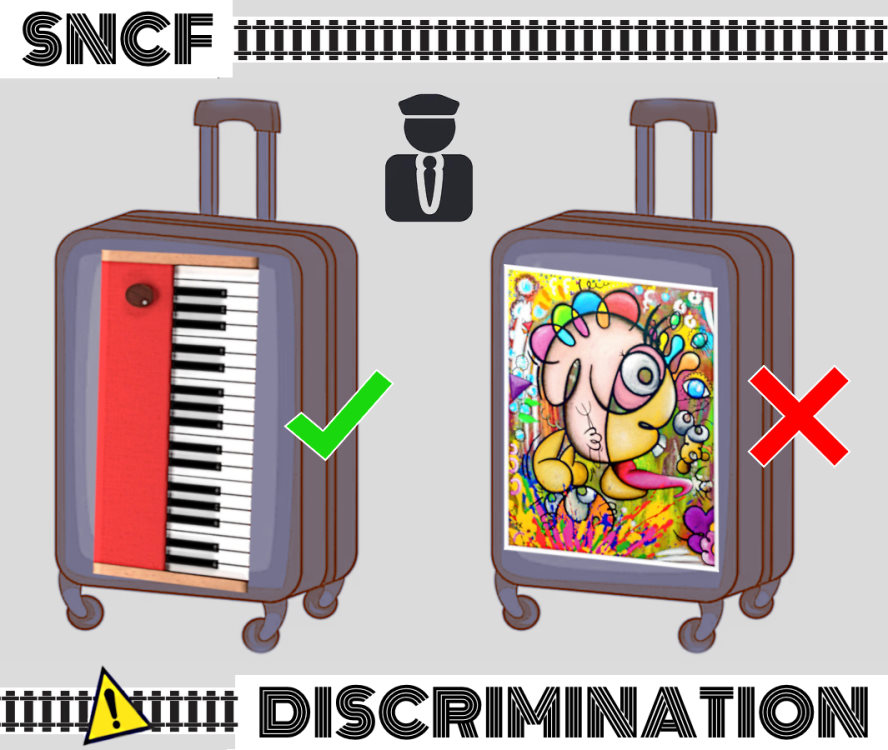
SNCF’s new luggage regulations
Starting in September 2024, SNCF changed its previous policy which required TGV INOUI passengers “to be able to carry themselves at once” all their luggage, replacing them with specific limits on the number and size of luggage allowed. For those who violate these regulations, the fine is set at a minimum of €50 per excess or non-compliant piece of baggage (maximum €150).
Apart from hand baggage (40 x 30 x 15 cm), you can travel on TGV INOUI with two pieces of luggage measuring 70 x 90 x 50 cm. Or one piece of luggage measuring 70 x 90 x 50 cm and one “special piece of luggage” measuring 90 x 130 x 50 cm.
But in this latter case, the “special piece of luggage” cannot contain just anything. It will be either : a folded scooter or stroller, a musical instrument, a water board, a snowboard or a pair of skis (no size limit for your skis) and PRM/PSH equipment for disabled people.
Items not included in this list are prohibited. Presented as such, this list of exemptions taken from page 35 of the Passenger Fare Guide seems innocuous and even nice for the athletes and musicians concerned.
And yet… By wanting to specify the nature of the contents of large bags allowed, hasn’t SNCF fallen into the insidious trap of discrimination ?
The concept of indirect discrimination
Allowing one traveler to carry luggage related to their musical practice while prohibiting another traveler from carrying the same luggage related to their painting practice appears to be a blatant case of “indirect discrimination” as defined by the French law No. 2008-496 of May 27, 2008 :
“Indirect discrimination occurs when a provision, criterion or practice appears neutral but is liable to result in (…) a particular disadvantage for some persons compared to others, unless that provision, criterion or practice is objectively justified by a legitimate aim (…)”
The question that arises, in the interest of both painters and the scientific community, is whether there is a legitimate criterion that justifies a cello in a 90 x 130 x 50 cm suitcase taking up less space than a painting on canvas in a suitcase of the same dimensions ? Or why should the supposed intentions and motivations of painters, compared to those of musicians during their respective journeys, warrant different commercial treatment for the former than for the latter ?
The 3 elements to establish discrimination
The ‘Defender of Rights’ (an independent administrative authority of the French government) who did not wish to take a stand on this issue – to which he very kindly said he was sensitive… – nevertheless affirms that the recognition of discrimination requires the presence of three elements :
First, it is “necessary to establish a difference in treatment between people in comparable situations.” This is precisely the case. It is impossible to distinguish the situation of a painter from that of a musician taking the same TGV at the same time, except that one is carrying a canvas and the other, in baggage of the same dimensions, a musical instrument. If the baggage is not opened, the situation of one is exactly the same as the situation of the other. Yet, their treatment is different: up to a €150 fine for the painter.
This differentiated treatment must then “apply within a domain stipulated by law. These domains are essentially : professional life (…) or access to a good or service (…)”. This differentiated treatment applies precisely to access to a service (access to public transportation), moreover a public service provided by a public company which is de facto in a monopoly position (with the responsibilities and duty to set an example that this entails) and whose latest official slogan (2021) is “SNCF. For all of us.”
Finally, the ‘Defender of Rights’, ever so sensitive to this situation, remember… adds that “this differential treatment must be explained by the consideration of a criterion of discrimination also prohibited by law (…)” The complete criteria (25) can be found on this page : service-public.gouv.fr/particuliers/vosdroits/F38175 which mentions, among other things, “ways of living” (“mœurs” in French), without further clarification or restriction. “Ways of living” are therefore not limited to the sexual sphere (and the former and infamous “brigade des mœurs”), which is itself subject to no fewer than three other specific and separate criteria : “sex,” “sexual orientation,” and “gender identity.”
In the general sense given by the dictionary of the French Academy, “mœurs” refers to “habits that characterize an individual’s way of being, their way of life.” In exactly the same situation, because I practice painting out of taste, as a hobby, or out of passion, choice of expression, or vocation (…), and a canvas related to my painting practice is in my piece of luggage, I am denied a right that is granted to me if I practice music and the same piece of luggage contains an instrument related to a different artistic practice.
One enigma remains : why such favorable treatment for musicians, from which painters are excluded ?…
Exceptions under pressure
An article in the newspaper Capital (https://www.capital.fr/economie-politique/sncf-la-nouvelle-regle-des-bagages-entre-en-vigueur-des-lundi-gare-a-lamende-1502338) on September 14, 2024 seems to reveal the real reason for the unfavorable treatment of painters compared to musicians. According to this article, the SNCF supposedly yielded to “the demands of musicians who regularly exceeded the permitted size limit.” Therefore, this difference in treatment between painters and musicians was never based on a criterion “justified by a legitimate aim” (law of May 27, 2008), but simply on pressure from disgruntled musicians…
Isn’t it the very definition of discrimination that one category of people has rights that another category of people, in exactly the same situation, does not have, solely because the first category exerted pressure to obtain a “special privilege” ? Either these rights must be granted to everyone, or they must be granted to no one.
SNCF. Discrimination for (almost) everyone ?
In conclusion, if the SNCF’s new regulations on the contents of the “special pieces of luggage” allowed on TGV trains weren’t a clear case of discrimination against painters, it would only be because, it seems, the railway company also excludes from its “special pieces of luggage” policy all athletes other than snowboarders, skiers, and scooter riders, and all artists other than musicians. And all passengers other than athletes and artists !…
Looking ahead…
Beyond discrimination, “over-policing” ?
While SNCF may have seemed to want to emulate the baggage restrictions in place at airports, it did not do so in exactly the same spirit. Lacking the legal authority of airport customs officials, it attempted to arrogate to itself rights that customs officers themselves do not exercise.
While airports only prohibit certain items based on objective security and the fight against illicit trafficking, SNCF wants to focus on the very nature of baggage, disregarding all security criteria, allowing some items and prohibiting others according to its own tastes, whims, subjective preferences, value judgments, and the pressure it may or may not have been subjected to. This inevitably leads to problems related to privacy and discrimination, and raises questions about the very status of ticket inspectors.
Because just as SNCF security agents – even armed with Tasers – are not police officers, ticket inspectors are not customs agents or judicial police officers and have no legal authority to search luggage.
This, by the way, renders the SNCF’s new ‘baggage’ policy legally unenforceable if the passenger, who isn’t easily fooled, refuses to open their baggage for verification of its contents at the ticket inspector’s request !…
The debates on the excesses of the use of police force in today’s society will never be complete if we do not also address the creeping and silent delegation of state power, already problematic enough in itself, to commercial companies and agents without police, customs or judicial qualifications, and who only show a very superficial attachment to the fundamental principles of law.


Comments ⏬
The gallery of Eric Bourdon
💕 Buy online now !



Paintings
Exhibitions
About the artist
Copyright
© Éric Bourdon
(unless otherwise mentioned)
59000 Lille, France
contact @ ericbourdon .com


Express yourself ! 😃